
Fused Deposition Modeling (FDM / FFF)
FDM melts aerospace-grade thermoplastic filament and extrudes it layer by layer inside a heated build chamber, so every part cools on a controlled schedule and prints with repeatable mechanical properties. It is the most widely used additive process in Aerospace & Defense, and highly engineered industrial applications today.
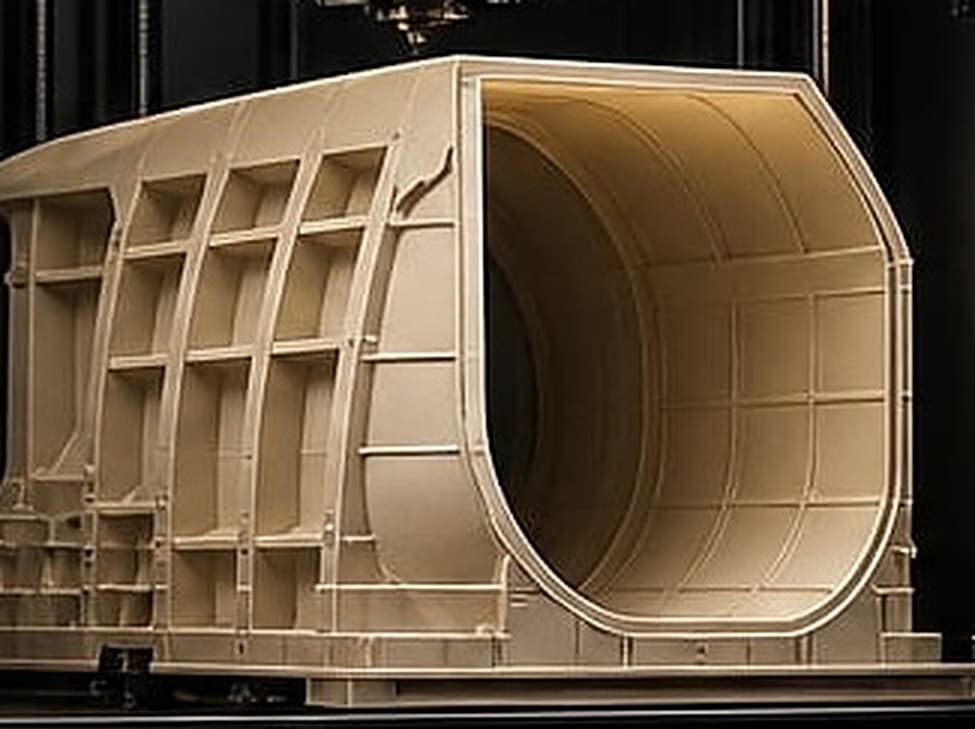
From CAD to production-ready parts.
- STEP / 01Aerospace-grade thermoplastic filament feeds into a heated extrusion head, where it is melted and driven through a precision nozzle.
- STEP / 02The nozzle traces each cross-section of your part, bonding new material to the layer below. The entire build happens inside a heated chamber, so every layer cools at a controlled rate. That controlled thermal history is the key to repeatable dimensional accuracy: parts hold tight tolerances from the first build to the hundredth, and meet the specified mechanical properties on every build.
- STEP / 03Soluble or breakaway support material is printed under overhangs, then removed in post-processing. Finished parts move to inspection with full material lot and process traceability.
- Aerospace cabin interiors
- ESD-safe electronics housings
- Composite layup tools
- End-use production parts
- Stratasys Fortus 900AIS/AICS qualified · large format
- Stratasys Fortus 450Full aerospace material range · VICTREX AM 200 PAEK qualified
- Stratasys Fortus 370Mid-volume engineering parts
Aerospace-grade materials we run.
PEKK-based thermoplastic for avionics, low-outgassing space hardware, and high-chemical-resistance applications.
The aerospace cabin standard: FAR 25.853 / OSU 65-65 compliant.
High-performance PAEK (PEEK-family) formulated for additive: thermal-critical hardware up to 300°F continuous use.
Higher heat and biocompatible: the choice for autoclave tooling and food-contact hardware.
Surface-resistivity controlled polymers for electronics, avionics, and radiation-sensitive hardware: no coating, no plating, no wear-through.
Heat-resistant FDM polymers for engine-adjacent, thermal-critical, and chemically aggressive service environments, with heat-deflection temperatures up to 419°F.
About FDM / FFF
Production-grade thermoplastic printing: the workhorse of aerospace additive manufacturing.
FDM is the process we reach for when your part needs to be large, durable, and built from a thermoplastic the aerospace industry already trusts. We run Ultem 9085, Ultem 1010, Antero 800NA, Antero 840CN03, and VICTREX AM 200 PAEK on our Stratasys Fortus 900 (AIS/AICS qualified), Fortus 450, and Fortus 370 systems.
Whether you need a single prototype or a recurring order of flight hardware, every job runs under our AS9100D quality system. Our large-format cell builds parts up to 36″ × 24″ × 36″ in a single piece, so large components don't have to be sectioned and bonded, and it provides the opportunity for part count reduction and assembly elimination.
This process runs at production scale for aerospace, defense, space, and industrial customers. If you have a part to quote, our engineering team will review geometry, material, and finishing requirements together, and can support you with design for additive manufacturing (DFAM).
Ready to take flight?
Let’s build hardware.
Send us your drawings, or just sketch on a napkin, and your program timeline. Our engineers will provide a rapid quote and deliver flight-ready parts built to your requirements and delivered on schedule.